

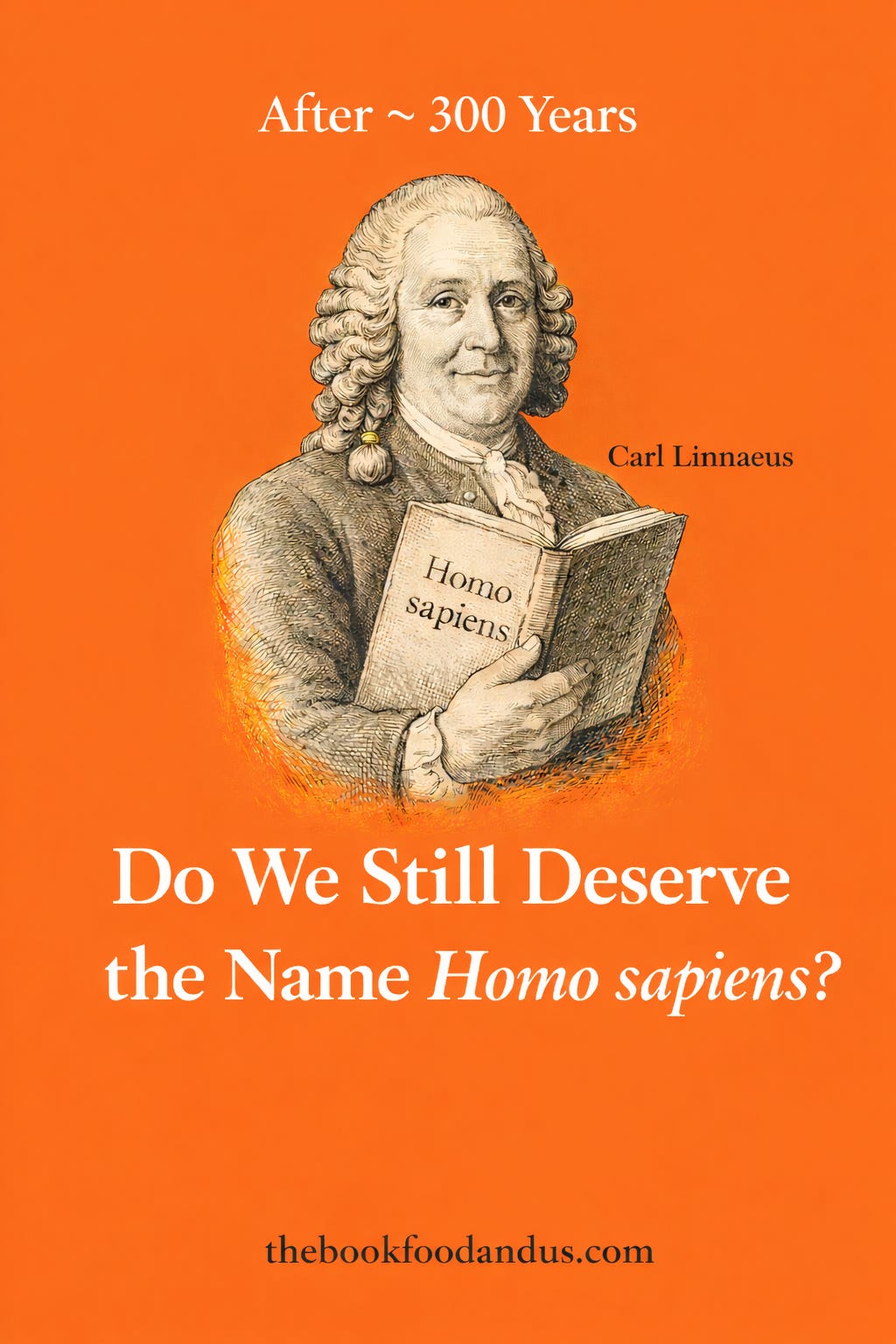
Carl Linnaeus named our species Homo sapiens—the “wise” human.
It was a confident, considered choice.
Linnaeus was not known for modesty. In his early thirties, he compared himself to Newton and Galileo, convinced he had transformed science. It’s hard not to wonder whether sapiens reflected not only humanity as he saw it… but also the qualities he believed he possessed.
His system of binomial nomenclature, developed in the mid-18th century, gave us a universal way of classifying life. Two words—genus and species—to describe what something is. Nearly 300 years on, we still use it.
But classification does not depend on intelligence. It depends on observable difference.
So imagine an objective observer, from another planet, given the same brief Linnaeus once set: observe the human species and assign a binomial name.
Biologically, the conclusion is straightforward. Humans belong to the Hominidae family, alongside chimpanzees and bonobos, and share roughly 98.6% of our DNA with our closest relatives. At the cellular level, the similarities are striking.
But step back, and the differences between humans and the rest of the Hominidae family become harder to ignore.
Our closest relatives live relatively simple lives. They forage, rest, and groom. Their diets are varied but fundamentally whole and unprocessed. They are not driven by convenience, optimisation or scale. And yet their biology remains broadly aligned with their environment. Their blood pressure does not steadily rise with age. Type 2 diabetes is rare. They do not accumulate excess body fat across populations.
Across human societies, the pattern is very different. Overweight and obesity—once rare—are now normalised at a global scale. The shift has happened far too quickly to be explained by genetics alone.
So what changed?
Not biological evolution. That moves too slowly.
What changed is the environment and our cultural evolution.
We no longer simply live within food environments; we create them. Food is processed, reformulated and engineered. Shelf life is extended, flavour optimised, and convenience prioritised. These are not accidental outcomes, but the result of systems designed for efficiency, scale and profit.
Over time, those systems don’t just shape behaviour. They begin to shape biology.
This idea sits at the heart of Food and Us: The incredible story of how food shapes humanity: that the environments we build influence not only what we eat but also who we become.
👉 First chapter free: https://thebookfoodandus.com/
The same pattern extends beyond food. Humanity’s ecological footprint now exceeds the Earth’s regenerative capacity by around 70%. In effect, we are using the resources of 1.7 planets, despite having only one. The systems we have designed—food, energy, production—are not only shaping our health, but the only habitat we have.
So if our observer were to name us today, it might pause before choosing the descriptor sapiens.
Not because we lack intelligence, but because intelligence alone is no longer the defining trait.
It might instead look at patterns. A species that reshapes its environment at scale: Homo transformans. Or perhaps more critically, a species that understands more than any before it, yet behaves in ways that consistently undermine the systems it depends on: Homo insipiens — the unwise one.
But that wasn’t Linnaeus’s method.
He did not classify based on philosophy, systems or cultural transformation. He named species based on observable differences. Two words. One distinction.
So the observer, adhering to the same logic, would have to return to the evidence. Same genus. Same lineage. Same near-identical DNA.
And then ask: what is the most obvious, measurable difference?
Not intelligence.
Not tool use.
Not social structure.
Because in many ways, those are shared.
What stands out—clearly and consistently—is something else.
No other primate accumulates body fat the way we do. No other species living under broadly similar biological constraints exhibits this level of metabolic disruption. Today, an estimated 2.5 billion adults worldwide are overweight.
Stripped back to what is most visible—not what we claim, but what we consistently exhibit—the classification becomes less flattering, but harder to avoid.
Homo adiposus — the fat human.
Not poetic. Not aspirational. But precise.
For most of history, food shaped us slowly.
Now, we may be shaping ourselves faster than biology can respond.
Because classification doesn’t describe who we think we are.
It describes what we’ve become.
And perhaps, uncomfortably, that is the more accurate reflection.
Join the discussion
If an observer arrived today and had to rename our species—based purely on evidence, not aspiration—what name would you choose?
And what would that say about the systems we’ve built?