

We teach children about atoms. We teach them about empires.
But we rarely teach them about the one thing that connects them both: food.
For generations, schools have taught mathematics, science, history, geography and literature. These subjects help us understand the world around us, how societies function, and how knowledge advances.
Yet one of the most influential forces in human history remains largely absent from the curriculum: Food. —the very force that helped shape our biology, our societies and the course of civilisation itself.
Despite shaping who we are, how we live and the civilisations we have built, many children leave school with only a limited understanding of where food comes from, how it affects their bodies, how it is produced, and how it influences the world around them.
Perhaps it is time to rethink that.
If mathematics teaches us how the world works, and history teaches us how we arrived here, then food helps us understand how biology, culture, economics and technology interact to shape the human experience.
The Forgotten Subject
Historically, food education occupied an uncomfortable position within many school systems.
Often taught under the banner of Domestic Science or Home Economics, it was frequently viewed as a practical subject rather than an academic one. In some countries, food education was aimed primarily at girls, reflecting the prevailing belief that cooking and household management were women’s responsibilities. Boys were more likely to be steered towards woodworking, metalwork and technical subjects, reflecting the gender expectations of the time.
These assumptions helped position food as a domestic skill rather than as a field of knowledge linked to science, health, economics and society. As education systems evolved, academic attainment increasingly focused on traditional disciplines, and food education was gradually pushed to the margins.
Ironically, at the very moment food systems are becoming more complex than ever before, our understanding of them is disappearing from mainstream education.
Today, many children can identify global food brands more easily than they can identify the crops from which those foods originate.
That should concern us.
Isn’t Food Education the Responsibility of Parents?
Many people would argue that teaching children about food is primarily a parental responsibility. In many respects, they are right.
Parents play a fundamental role in shaping food preferences, eating habits and family traditions. For thousands of years, this was how food knowledge was passed from one generation to the next.
But the modern food system bears little resemblance to that experienced by previous generations.
Parents themselves are navigating a world of conflicting nutritional advice, sophisticated marketing, social media influences, sustainability claims, novel food technologies and rapidly evolving scientific knowledge.
Just as schools help children understand the natural world through science and society through history, they can help them understand food through the lens of biology, culture, economics and the environment.
Food education should therefore be viewed as a partnership between home and school rather than the responsibility of either alone.
The reality is that food choices no longer affect only individual households. They influence public health, healthcare costs, environmental sustainability, economic productivity and the resilience of entire food systems.
Food literacy has become a societal necessity.
More Than Nutrition
One reason food has struggled to find a place within education is that it does not fit neatly into a single subject.
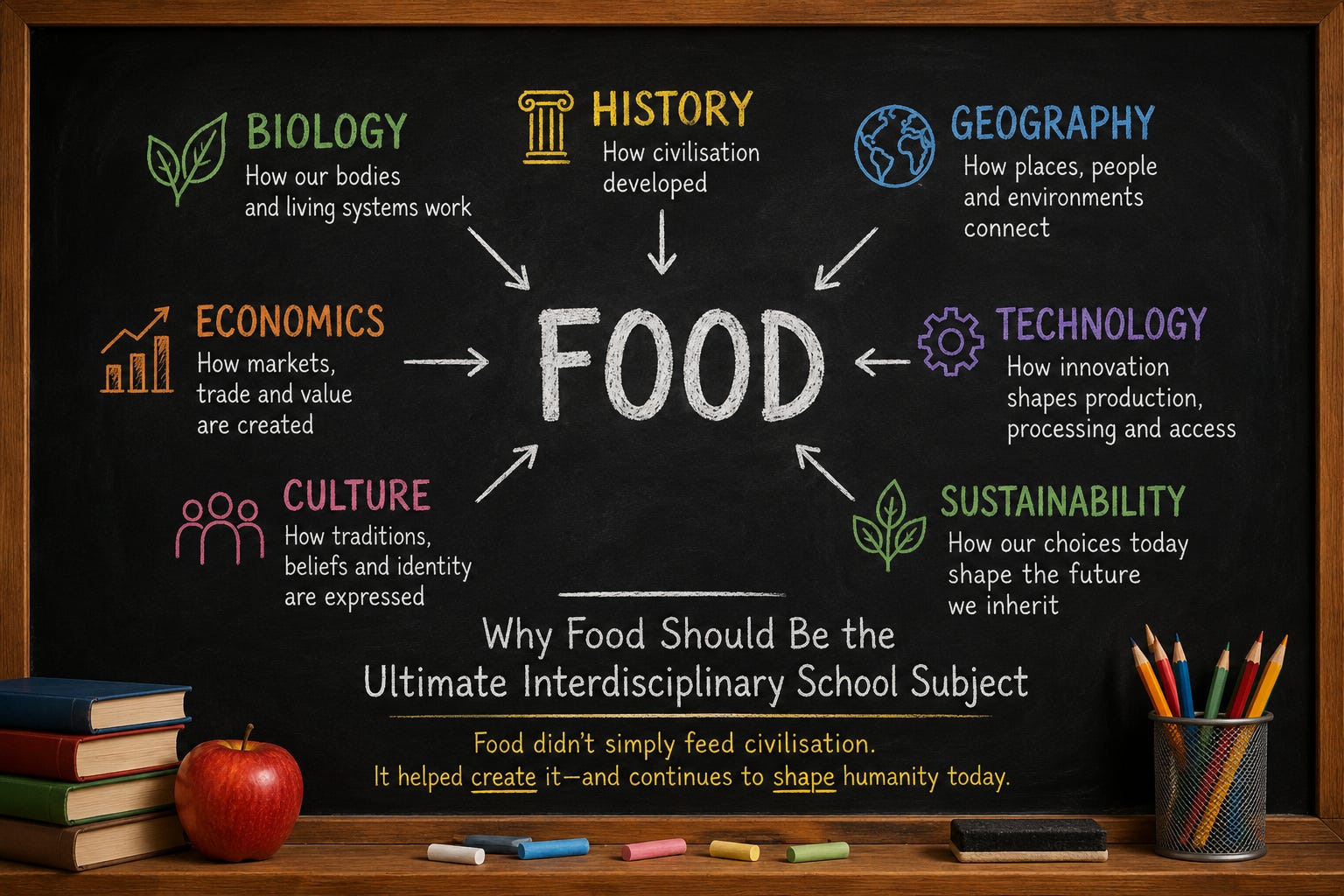
Food is often treated as a matter of nutrition, yet it extends far beyond what appears on our plates. Understanding food requires an appreciation of biology and chemistry, as well as history, geography, economics and technology. It touches politics and culture, influences environmental sustainability, and helps explain how societies develop and function.
Through food, students can explore how humans evolved, how agriculture transformed civilisation, how trade connected continents, how markets and money emerged, how technology changed production and consumption, and how modern food systems influence both human and planetary health.
To understand food fully requires an understanding of how our bodies function, how ecosystems operate, how civilisations developed, how markets work, how technology influences behaviour and how political decisions shape societies.
Food is, therefore, not merely another subject. It is a framework through which students can better understand the world around them, their place within it, and the biological, cultural and economic forces that continue to shape humanity.
Understanding Ourselves Through Food
Perhaps the most fascinating aspect of food education is that it is also an education about ourselves.
The story of food is inseparable from the story of humanity.
For millions of years, our ancestors evolved in response to the food available to them.
The control of fire and the development of cooking transformed the availability of energy and nutrients, helping support larger brains and more complex societies.
Agriculture changed everything. It transformed nomadic hunter-gatherers into settled communities. Food surpluses enabled population growth, cities, governments, taxation, organised religion and specialised labour.
Ownership of land altered social structures. Trade routes connected continents. Markets emerged.
Money evolved partly as a mechanism for exchanging goods and resources. In many respects, food sits at the centre of human physical evolution, cultural evolution and economic development. Yet these connections are rarely explored together. History is taught separately from biology, economics is taught separately from ecology, and technology is taught separately from nutrition—even though food sits at the centre of them all.
Following the Science
.Our understanding of food has evolved dramatically over the past century. In the late nineteenth century, scientists focused largely on calories and energy measurement, while the mid-twentieth century brought greater emphasis on food groups, balance and dietary guidelines.
The twenty-first century introduced genetics, personalised nutrition and microbiome science, followed more recently by growing interest in food processing and how foods are manufactured, formulated and consumed.
As our scientific understanding has evolved, so too have the questions we ask.
Future generations will need to understand not only what food contains, but how food systems interact with biology, behaviour and society. They will also need to understand how psychological and biological mechanisms that evolved over millions of years to help humans survive periods of scarcity now operate within a world of unprecedented food abundance.
The instincts that once encouraged us to seek out sugar, fat and calories were vital for survival. Today, those same instincts are targeted by sophisticated food technologies, marketing systems and highly accessible food environments. The challenge is no longer finding enough food. Increasingly, it is understanding how our ancient biology responds to a modern food system unlike anything our ancestors experienced.
Understanding food in the twenty-first century, therefore, requires more than nutritional knowledge. It also requires an understanding of ourselves.
Food Literacy for a Complex World
The concept of food literacy has emerged as a response to this growing complexity. It extends beyond cooking skills and nutritional knowledge to encompass an understanding of food’s relationship with health, culture, economics, society and the environment, enabling people to make informed decisions within increasingly complex food systems.
Unfortunately, comprehensive food literacy programmes remain rare. While many education systems include elements of nutrition, cooking, health or sustainability, these topics are often taught in isolation rather than as part of a coherent framework linking food, biology, culture, economics, technology and the environment.
Norway is frequently cited as one of the leading examples, having embedded food, health and sustainability more systematically within its national curriculum. Even so, integrated food literacy programmes remain the exception rather than the rule.
The result is a generation expected to make increasingly complex food decisions without ever being taught how.
School Meals as Living Classrooms
Education does not happen only through textbooks. Every school meal is an opportunity to learn.
Well-designed school meal programmes improve nutrition, educational outcomes and health while providing practical examples of food systems in action. School menus can introduce children to seasonal produce, diverse grains, local agriculture, and sustainable farming practices, helping them understand how food choices connect to health, the environment, and culture.
School cafeterias could become classrooms.
At the same time, school meal programmes can support local agriculture, encourage more sustainable food production and help ensure that every child receives at least one balanced meal each day.
Preparing Children for the Future
The children entering school today will inherit a world facing challenges unlike those encountered by any previous generation. Climate change, biodiversity loss, food insecurity, rising healthcare costs, artificial intelligence, personalised nutrition and emerging food technologies will all shape the environment in which they live and work.
The decisions they make will influence not only their own health and well-being, but also the sustainability and resilience of the societies and ecosystems they inherit.
As a result, future generations will require a level of food understanding that previous generations never needed. The food choices of the future will involve far more than selecting products from a supermarket shelf. They will increasingly require an understanding of health, sustainability, technology, data and the complex interactions between food systems and society.
Fortunately, tomorrow’s students will also have unprecedented access to information. Artificial intelligence and personalised digital assistants may one day provide real-time dietary advice, nutritional guidance and health insights tailored to individual needs.
Yet technology alone cannot solve these challenges. It can support informed decision-making, but it cannot replace understanding. The ability to interpret information, question assumptions and understand the wider implications of food choices will remain an essential human skill.
Food, Education and the Future
Perhaps the greatest opportunity is not simply to teach children about food. It is to use food as a framework for understanding the interconnected world in which they live.
Understanding food requires an understanding of human biology, psychology, ecology, history, economics, technology, and culture. It also requires an appreciation of how our bodies function, how societies developed, how markets emerged, how technology shapes behaviour, and how our choices influence both people and the planet.
Few subjects offer such a broad perspective.
Food connects our biology to our behaviour, our history to our future, and our individual choices to global outcomes. It helps explain how humans evolved, how civilisation emerged and how modern societies function. It also helps us understand many of the challenges we face today, from public health and food security to sustainability and climate resilience.
For centuries, we have tended to view food as a domestic, health, or agricultural issue. In reality, it is all of these things and much more. Food is one of the few subjects capable of bringing together the natural sciences, social sciences and humanities into a single coherent story.
Perhaps the challenge for future education is not finding room for another subject. Rather, it is recognising that food already sits at the intersection of many subjects we teach today.
If mathematics helps us understand how the world works, and history helps us understand how we arrived here, then food helps us understand how biology, culture, economics and technology interact to shape the human experience.
That is why food should be more than a topic within the curriculum.
It should become one of the frameworks through which the curriculum is connected.
After all, food did not simply feed civilisation. It helped create it—and continues to shape humanity today
.