

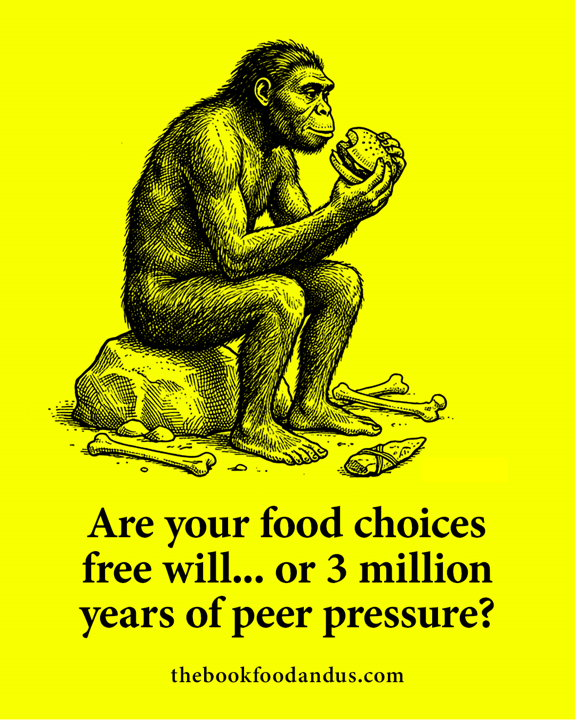
“The only constant is change,” the Greek philosopher Heraclitus observed 2,500 years ago. Few areas of human life illustrate that better than food. As outlined in Food and Us, the Incredible Story of How Food Shapes Humanity, over the last three million years, what we eat has shaped not only our bodies but also our cultures, economies, and beliefs. Today, as our food system strains human health and planetary limits, that long relationship is entering another pivotal moment.
From the moment our ancestors stood upright, food became the fuel of human evolution. It powered our growing brains, enabled migration, and laid the groundwork for cooperation and culture. Long before food became a “product,” it was an expression of care, identity, and survival. To this day, feeding a child remains one of the first acts of love we perform; nourishment quite literally binds us together.
Throughout history, food has held significant spiritual meaning across various civilisations. Ancient Indians referred to yoghurt and honey as “the food of the gods.” Mesoamerican cultures regarded cacao as sacred. The word “bread” appears 472 times in the Christian Bible. Even our language reflects food’s cultural importance: the term Carnival comes from “carne vale,” which means “farewell to meat,” as per the Venetians, it signified a period of indulgence before a time of restraint for their fasting period of Lent.
Food didn’t just shape culture; it shaped power. When humans shifted from hunter-gatherer societies to agriculture, surplus grain enabled the emergence of the world’s first currencies and hierarchies. Control of food supply became control of people. In many ways, modern economies still rest on that foundation.
Then came the Industrial Revolution—and with it, a transformation as dramatic as the agricultural one before it. Food production scaled rapidly to feed swelling urban populations. Contrary to dire Malthusian predictions, the food supply outpaced population growth. The global population grew eightfold in just two centuries. But this success has not come without hidden costs.
Unlike other industries, food exists to meet a biological need, not simply to generate a profitable income stream. Yet during the 20th century, food increasingly adopted the logic of modern capitalism: efficiency, scale, branding, and margin optimisation. Management theories designed for cars or computers were applied to calories. The result? An industry astonishingly successful at producing abundance—and increasingly disconnected from human biology.
Today, the global Agrifood industry is valued at approximately $12 trillion and employs approximately 40 per cent of the global workforce. From an investment standpoint, it has been one of the most profitable industrial sectors over the past 60 years. But profitability has not equated to well-being.
Consider the paradoxes. A pharmacist’s remedy for morphine addiction becomes the world’s most consumed soft drink. A cereal invented to suppress sexual desire becomes a breakfast staple. A fast-food logo, engineered using colour psychology and Freudian symbolism, becomes one of the most recognisable icons on earth. Portion sizes double. Calories get cheaper. Marketing gets smarter.
At the same time, nature begins sending warning signals. The agri-food system is now responsible for nearly one-third of global greenhouse gas emissions. One-third of all edible food is wasted, while hundreds of millions still go hungry. Obesity rates in countries like the US and UK have more than tripled in three decades, with one billion people projected to be living with obesity by 2030.
This isn’t simply about individual willpower. Our food environment has changed faster than our biology can adapt. Ultra-processed foods exploit our innate preference for calorie-dense nutrition while stripping out fibre and protein—the very signals that help regulate appetite. The result is overconsumption by design.
The hidden costs are staggering. For every dollar spent on food, society incurs roughly two more dollars in health, environmental, and economic costs. When viewed holistically, our food system is no longer cheap—it’s extraordinarily expensive.
Yet humans are not static. We are still evolving, both biologically and culturally. Genetic adaptations—such as lactose tolerance in northern Europeans or plant-fat metabolism in long-standing vegetarian populations—show how diet and DNA interact over time. However, our cultural evolution is now changing at an accelerated pace. I.e. our shift from rural to urban, agriculture to commerce, isolation to interconnectedness, less to more technology and education, lesser to greater wealth and smaller families/household units. Unlike genetics, our social systems can change within a generation.
That is the opportunity before us.
The future of food cannot rely solely on taste, price, and convenience. New drivers are already emerging health and wellness, environmental sustainability, social impact, and meaningful experience. Consumers are asking different questions—not just “Does this taste good?” but “Is this good for me?” “For farmers?” “For the planet?”
Ancient wisdom offers a clue. The Chinese character for vitality, Jing (精), combines the symbols for rice and plants—an elegant reminder that nourishment and life force are inseparable. Confucius urged us to study the past to define the future. When it comes to food, that advice may be exactly what we need.
Food made us human. The next challenge is ensuring it helps us remain healthy—both as individuals and as a species. Change is inevitable. The question is whether we shape it consciously or let it shape us once again.
Change is coming but will it come fast enough!?