

For more than a century, scientists, policymakers and the food industry have been trying to answer a deceptively simple question:
What should humans eat?
The answers have changed repeatedly.
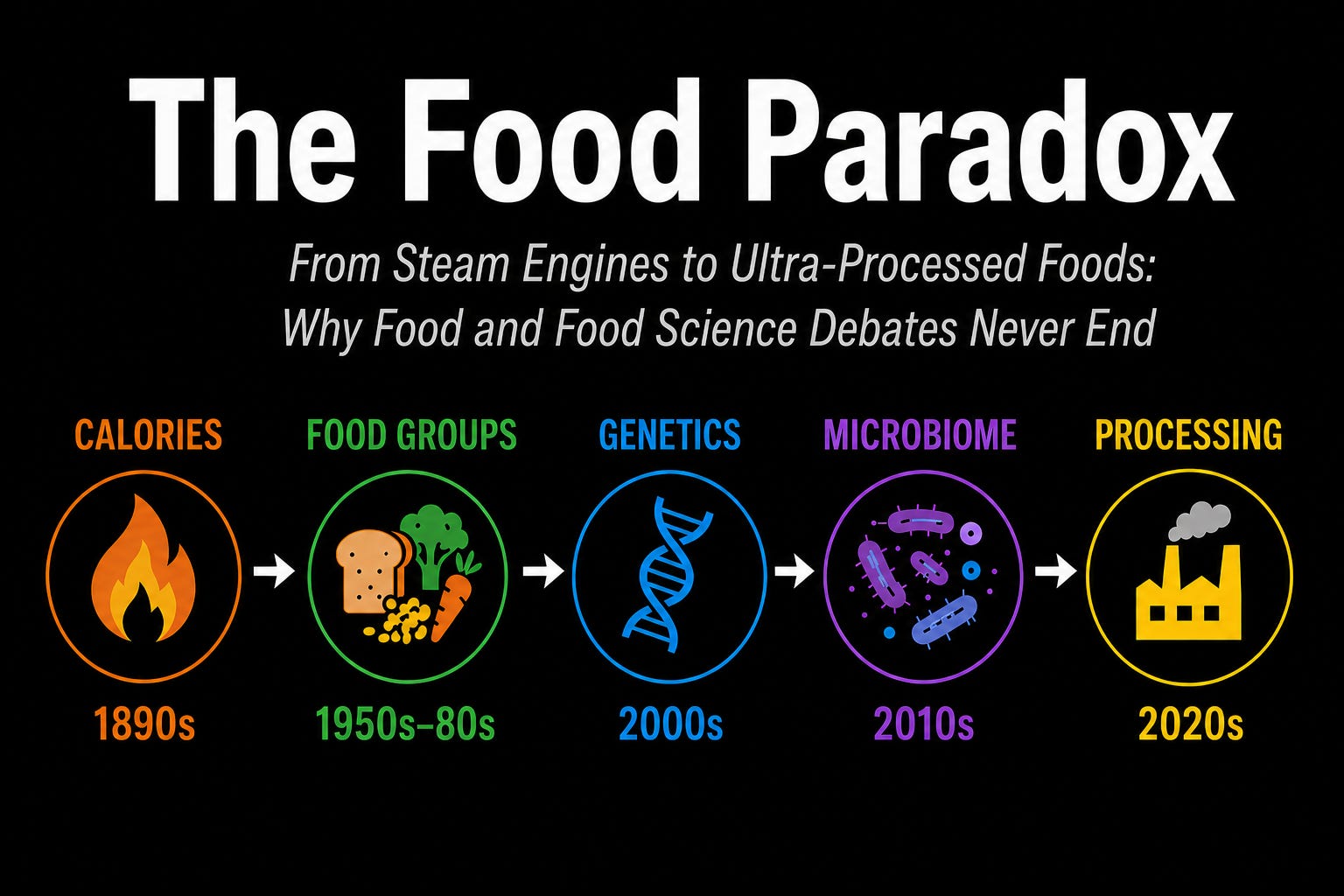
First came calories. Then food groups. Then fat. Then sugar. More recently, genetics, the microbiome and ultra-processed foods have entered the debate.
Each new theory promises greater clarity. Yet obesity, diabetes and diet-related disease continue to rise across much of the developed world. Consumers have never had more dietary advice, yet many have never been more confused.
Perhaps the problem is not that nutrition science has been wrong.
Perhaps it is that food has changed faster than our ability—and our biology—to adapt.
When Food Became Fuel
Our modern food science story starts in the late nineteenth century, when Louis Pasteur helped make food safer and American scientist Wilbur Olin Atwater sought to understand how much energy it contained. He developed the calorie system that still appears on food labels today.
His work gave us the familiar formula:
Carbohydrate = 4 calories per gram
Protein = 4 calories per gram
Fat = 9 calories per gram
For the first time, food energy could be measured, compared and quantified.
Yet Atwater’s breakthrough rested on a simple assumption: food could largely be understood as fuel and the human body as the machine that burned it. The analogy made sense in an age fascinated by steam engines, industrial efficiency and scientific measurement.
The problem is that humans are not steam engines.
A bomb calorimeter measures the heat released when food is completely burned. Human biology is far more complex. Digestion, hormones, satiety, food structure, genetics and the microbiome all influence how food affects the body.
Today we know that 100 calories of almonds are not metabolically identical to 100 calories of a sugary drink, despite containing the same theoretical energy.
Even today, food-labelling regulations allow actual calorie counts to differ from those displayed on packaging by as much as 20%.
For a system that can be off by as much as 20%, calories continue to hold remarkable authority. Not because they are perfect, but because they provide a simple framework for understanding a complex reality.
The challenge is that such simplicity can sometimes obscure as much as it reveals.
From fat to Processing
By the middle of the twentieth century, the nutritional spotlight shifted from calories to fat.
Led by influential researchers such as Ancel Keys, attention increasingly focused on the relationship between dietary fat, cholesterol and heart disease. Governments developed dietary guidelines, manufacturers launched waves of low-fat products and consumers learned to scrutinise fat content.
Keys was a forceful personality. When challenged about dietary choices, he famously remarked:
“If people want to eat themselves to death, let them.”
With hindsight, the fat debate was neither entirely right nor entirely wrong. It represented another step in a much larger scientific journey.
As scientific understanding evolved, attention shifted again. Sugar came under increasing scrutiny following John Yudkin’s Pure, White and Deadly. Then came genetics. Then the microbiome. More recently, attention has turned towards food processing itself.
The question was no longer simply:
“How much energy does food contain?”
It became:
“How does food interact with human biology?”
While Nutrition Science Evolved, Food Science Transformed Food
While nutrition scientists debated calories, fat and sugar, another scientific revolution was taking place.
Food science.
Its objectives were different.
Food scientists were not primarily asking how food influenced long-term health. They were trying to make food safer, cheaper, more convenient, more reliable and more widely available.
By almost any commercial measure, they succeeded.
Throughout the twentieth century, food science transformed the global food supply. Refrigeration improved safety. Preservation technologies extended shelf life. Manufacturing innovations reduced costs. Distribution systems delivered food to rapidly growing cities.
For billions of people, food became more affordable and accessible than ever before.
As competition intensified, however, food scientists also became increasingly adept at reformulating products. Expensive ingredients could be replaced with cheaper alternatives. Whole ingredients could be fractionated into their component parts and recombined in new ways. Emulsifiers improved texture, preservatives extended shelf life, flavour systems enhanced taste, and high-fructose corn syrup provided a low-cost sweetener for countless applications.
Food became increasingly reformulated.
Not because anyone set out to create a public health crisis.
But because companies were responding to consumer demand for affordability, convenience and enjoyment while simultaneously meeting shareholder profit expectations.
The Search for the Bliss Point
In the Seventies, one of the most influential developments came from psychophysicist Howard Moskowitz and his work on the so-called “bliss point”—the precise combination of sweetness, saltiness, fat and texture that maximises consumer pleasure.
Food companies discovered that taste preferences could be measured and optimised with remarkable precision.
The goal was no longer simply to make food edible. It was to make food difficult to resist.
The result was a food environment unlike anything encountered during most of human evolution.
For millions of years, humans lived in environments where calories were scarce and obtaining food required effort. Today, highly palatable foods are available almost everywhere, often at very low cost.
Interestingly, human breast milk is one of the very few natural foods that combines significant amounts of both fat and carbohydrate in a similar balance—nature’s perfect food for supporting rapid infant growth. Many modern manufactured foods are deliberately formulated around similar combinations because they strongly appeal to human taste preferences.
The Processing Paradox
Until now, most nutritional debates have focused on what food contains.
The latest chapter focuses on what happens to food before we eat it.
The NOVA classification system asks a fundamentally different question: not simply what food contains, but how it was made.
Critics argue that processing exists on a spectrum and that not all ultra-processed foods are nutritionally equivalent. These are legitimate scientific concerns.
Calls for “more research” are now a familiar refrain in the NOVA debate. In truth, every major theory in the history of nutrition has required more research. Calories did. Dietary fat did. Sugar did. The microbiome certainly does. There is little reason to believe food processing will be any different.
The irony is that the same advances in food science that improved safety, affordability and shelf life also enabled the creation of increasingly complex manufactured foods.
Having spent decades developing technologies that transform whole ingredients into highly processed products, parts of the industry now question whether processing itself matters.
Perhaps they are right. NOVA and it’s UPF category 4 is undoubtedly a simplification.
But then so too is the calorie system.
Calories reduce food to energy. NOVA reduces food to degrees of processing. Neither captures the full complexity of human biology.
Yet perfection has never been the standard by which scientific frameworks are judged.
Despite calorie values being allowed to vary by up to 20%, the calorie system remains enormously influential because it offers a useful way to understand a complex reality.
Perhaps the same principle applies to NOVA. It may not explain everything. It may not be 100% correct. It may evolve or eventually be replaced.
But if it helps identify meaningful patterns between modern food processing and human health, it may still prove valuable.
And if food science has fundamentally changed the structure, composition and sensory characteristics of many foods, it seems entirely reasonable to ask whether those changes matter biologically.
The Human Biology Paradox
As explored in Food and Us, humans did not simply evolve with food; food helped shape human biology itself.
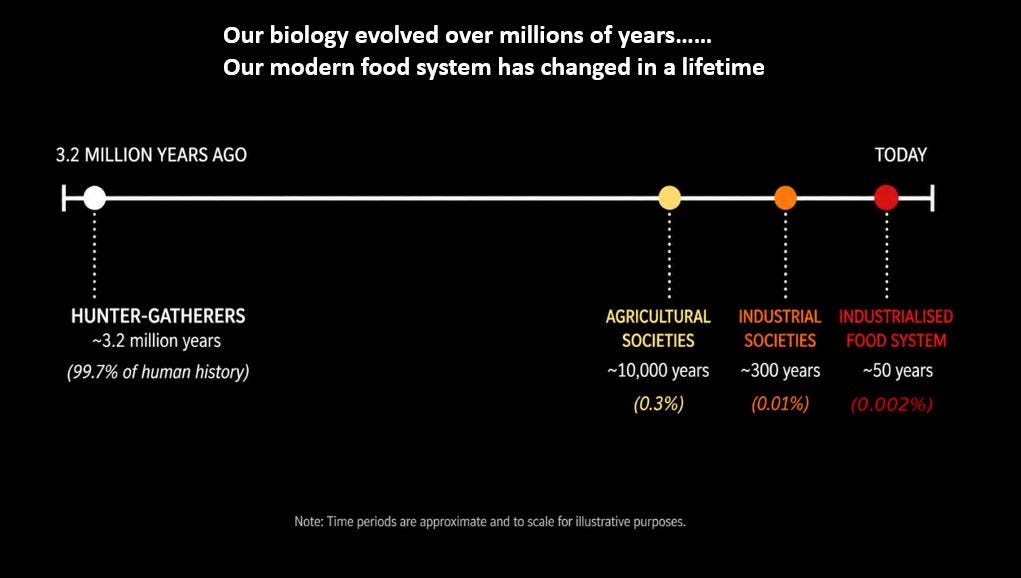
For almost three million years, our ancestors adapted to foods that were hunted, gathered, cultivated and minimally processed.
Yet we have transformed the food environment beyond recognition in little more than a century—roughly 0.002% of our evolutionary history.
Nutrition science has steadily expanded our understanding of human biology.
Food science has steadily expanded its ability to manipulate taste, texture, convenience and cost.
Both have achieved remarkable success.Yet they were often solving different problems.
Science has evolved because food has evolved. But while our diet has changed dramatically within a few generations, our biology, which evolved over millions of years, remains largely unchanged.
The question is no longer whether we can produce enough food.
The question is whether we can create food systems that better align commercial success, human health and environmental sustainability.
This is a great read, and framing the history as a series of useful-but-imperfect simplifications is a sharp way through a debate that usually just relitigates each theory.
The calorie/NOVA parallel is the strongest part, and it may hold tighter than you draw it. Both reduce food to a single axis, energy or degree of processing, and each survives because that axis tracks something the fuller biology cares about. Where they part is the failure mode: a calorie count off by 20% still points the right way, but NOVA can put a fortified wholegrain loaf and a candy bar in the same bin. One fails by magnitude, the other by category, which is basically what the UPF fight is about.
Thank you for your thoughtful comments on this debate. I think you've captured one of its central dilemmas extremely well.
Our understanding of human biology, nutrition and the food matrix continues to evolve. Despite remarkable advances in recent years—including our growing understanding of the gut microbiome—we simply don't yet have all the answers.
Against that backdrop, I think NOVA, despite the polarised views within food science both for and against it, has made an important contribution. It may not be a perfect scientific classification, but it provides consumers with a simple and practical indicator that, more often than not, points them in the right direction. Like calories before it, its greatest strength may be its simplicity rather than its precision.
Perhaps the bigger challenge is that no single measure can fully capture the complexity of food or human biology. That is why I believe the debate continues—and why a deeper understanding of our biology, our microbiome, and the foods we are best adapted to eat may ultimately prove to be the more fundamental question.