

The quiet shift we rarely noticed
Not long ago, food was local, personal, and social.
In Britain—long described as “a nation of shopkeepers”—and in communities across the world, the grocery store, along with the butcher and the greengrocer, sat at the centre of daily life.
Shopkeepers earned their livelihood selling food and local provisions. Food was weighed, sliced, wrapped, and passed across the counter. Conversations were important. People kept aware of what was happening in their community. It wasn’t just a transaction. It was a social relationship. Today, that world has all but vanished.
When food shopping became a system
In 1916, a store called Piggly Wiggly opened in Memphis. It introduced something radical: self-service.
Customers no longer asked. They chose.
By the mid-20th century, this model spread rapidly. In the UK, supermarkets expanded aggressively, driven by a simple idea—“pile it high and sell it cheap,” as Tesco founder Jack Cohen famously put it.
Legislative change reinforced the shift. The removal of resale price maintenance in the 1960s allowed large retailers to compete primarily on price, accelerating a fundamental restructuring of the food retail system.
By 2000, independent retailers had collapsed from around 80% market share to just 18%.
And with scale came something more powerful:
Control over what reaches the shelf.
From scarcity to abundance
This transformation delivered something unprecedented.
More affordable food.
Global supply chains.
Just-in-time delivery. Private label products. Year-round availability.
Consistency at scale.
It is, in many ways, one of humanity’s most significant retail achievements.
But every system optimises for a specific goal. And optimisation always involves trade-offs.
The supermarket is not neutral
A supermarket is no longer simply a place to buy goods.
It is a designed environment.
Every detail is intentional:
Layouts that guide your movement
Essentials are placed at the back of the store
Promotions positioned at eye level
Bundled “value” deals to increase volume
Even music is designed to influence pace and mood. Studies suggest that up to 50% of purchases are impulse-driven. And if you enter the store hungry? The system becomes even more effective.
Behaviour first. Biology follows.
We often think of food choices as personal decisions.
But behaviour is shaped by our environment.
And our environment is shaped by systems.
Today, those systems extend far beyond the supermarket:
Fast-food outlets
Delivery platforms
One-click purchasing
Together, they form a designed food environment operating at scale.
And over time, that system shapes:
What we eat
How often we eat
How much we eat
And ultimately… our biology.
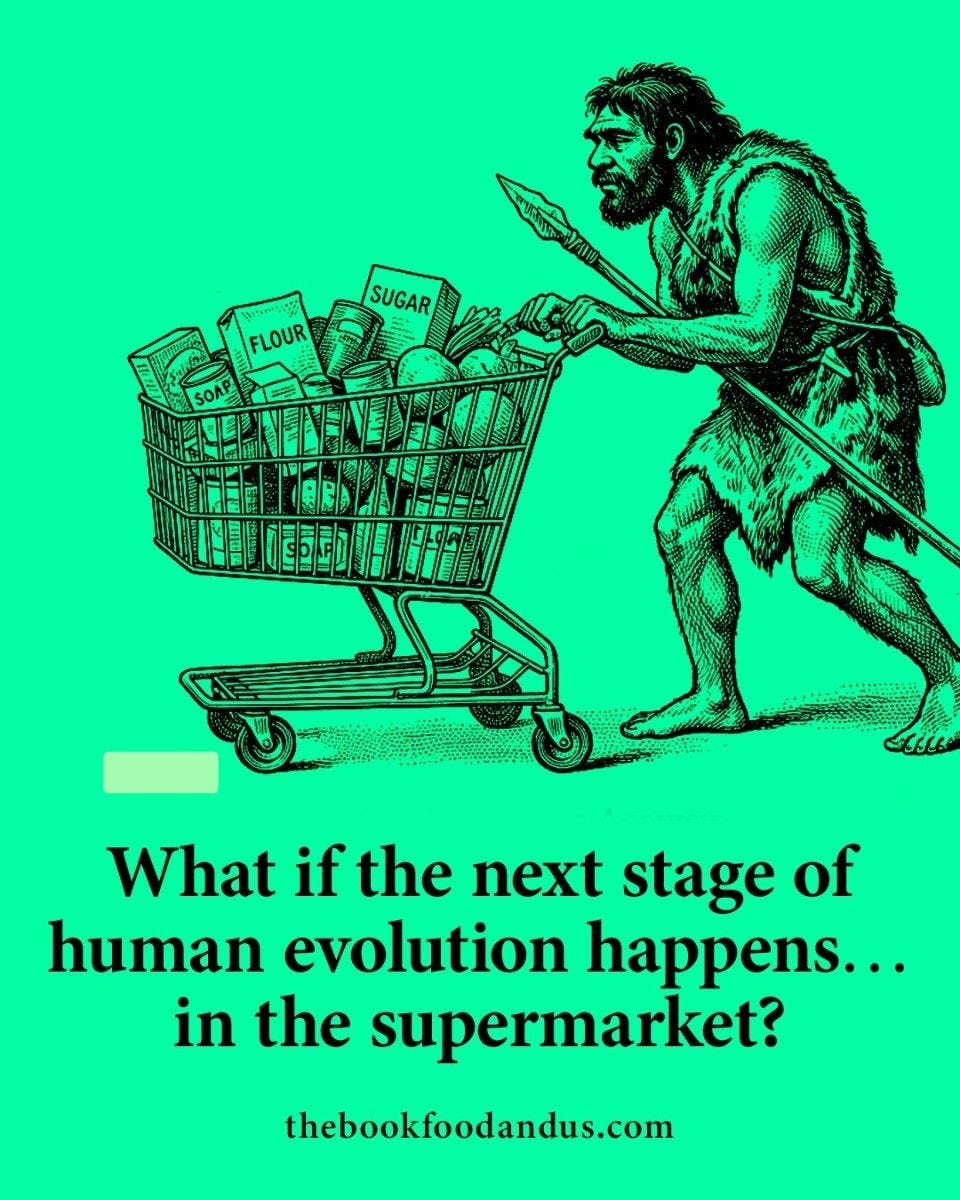
A different kind of evolution
For millions of years, natural selection shaped humanity through scarcity, effort, and survival.
Today, those pressures have been replaced by abundance, convenience, and constant availability.
We are no longer adapting to food scarcity. We are adapting to predesigned food systems.
A different kind of selection pressure
In a supermarket:
High-margin products are positioned for visibility
Shelf placement influences choice
Promotions influence volume
Loyalty data shapes what appears next—and where
The question is no longer:
What do humans choose?
But:
What are humans most likely to choose in the environments we design?
Behind the shelves
Behind the shelves lies another system.
Suppliers negotiate for space.
Margins are traded for visibility.
Innovation is shaped by access.
Supermarkets are not just distributors.
They have become gatekeepers.
And gatekeeping shapes outcomes:
What gets produced
What gets scaled
What reaches the consumer
The system doesn’t just respond to demand. It helps create it.
So where does evolution happen now?
Not in the wild.
Not in isolation.
But in environments like this:
Supermarkets
Fast-food chains
Digital food platforms
Places where systems shape behaviour—
and behaviour, over time, shapes biology.
Final thought
For over 3 million years, as discussed in Food & Us, food has gradually shaped us. Now, systems might be shaping us more quickly than we can adapt. Not because of what food is—
but due to how it is delivered, positioned, and made easy to choose.
Optimised for efficiency, scale, and profit—
not for the body’s biological needs.
If evolution once happened in nature… What happens when it moves into the supermarket?
If the idea that systems shape behaviour—and behaviour shapes biology—interests you, I explore it further in Food & Us. The Incredible Story of How Food Shapes Humanity. It traces how food has influenced human development for over 3 million years—and why that story is still unfolding.
Read the first chapter:
https://thebookfoodandus.com/
Bottom of Form